
Knee
Does Every Meniscus Tear Need Surgery?
- Meniscus tear
- Knee arthroscopy
- Conservative treatment
- Knee pain
Written by: Dr. Osama Samir Al-Droubi · Specialist in orthopedic surgery, fractures, sports medicine and joint reconstruction
Published by: Dr. Osama Samir Al-Droubi's clinic · Salmiya, Kuwait
Last updated:
Not every knee meniscus tear needs surgery. Learn how symptoms, tear characteristics, knee function, and response to conservative care guide treatment.
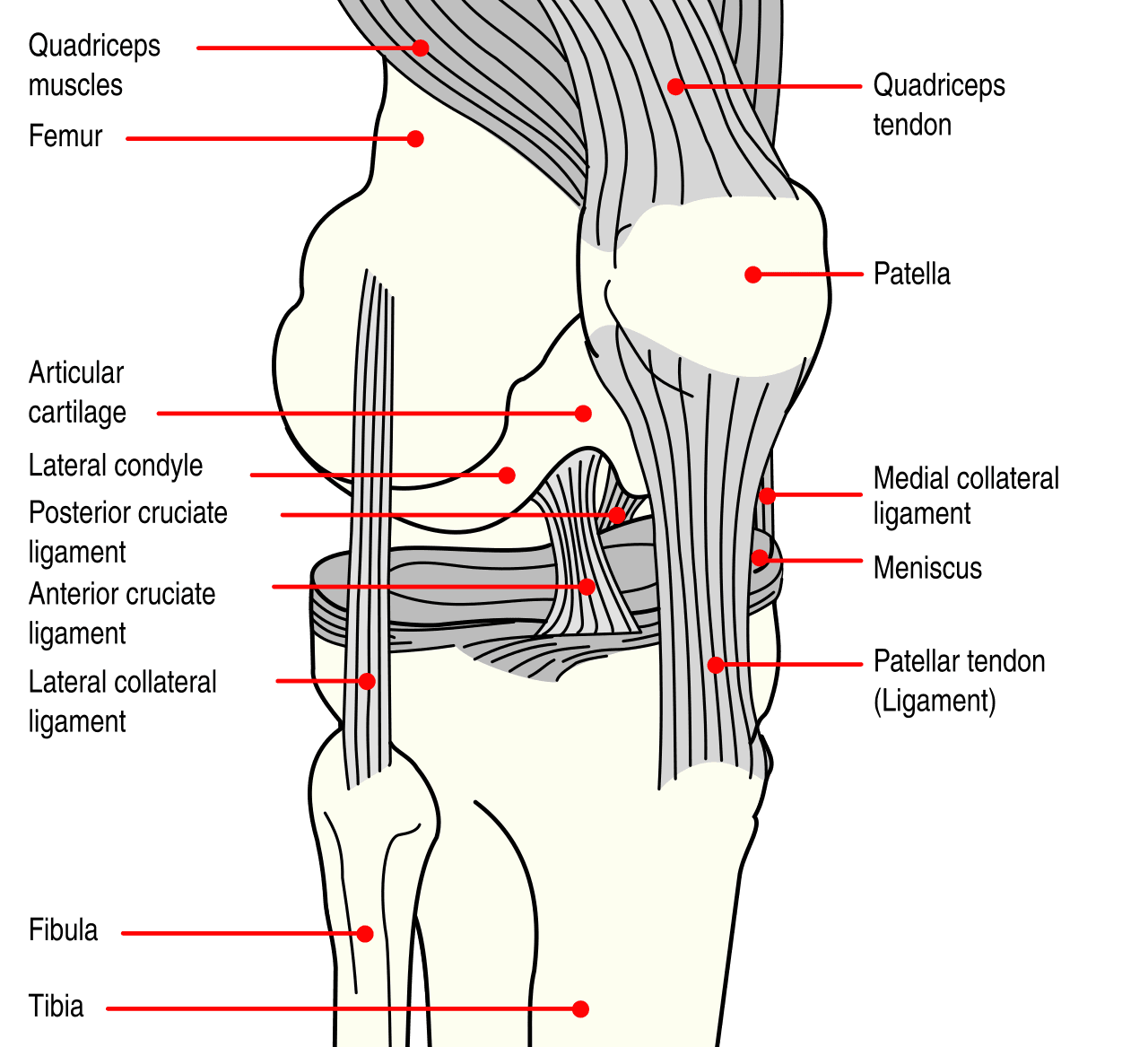
Anatomical diagram of the knee joint, ligaments and cartilage
Image credit: Mysid · Public domain · Rendered as PNG

When a knee meniscus tear is diagnosed, many patients assume surgery is the only solution. This is not the case. Some tears can be treated without surgery, while others need an operation depending on the type of tear, symptom severity, and the effect on knee movement.
What is a meniscus tear?
The knee meniscus helps absorb shock and distribute load within the joint. A tear may cause pain, swelling, or difficulty moving, although symptoms vary from one case to another.
Does every meniscus tear need surgery?
No. The decision depends on several factors, including:
The type of tear.
The size and location of the tear.
The patient's age.
The severity of pain.
Knee locking or catching.
The effect on everyday activities or sport.
The response to conservative treatment.
Some tears are small or do not cause severe symptoms and can be managed without surgery.
When can a meniscus tear be treated without surgery?
Conservative treatment may be suitable if:
Symptoms are mild or moderate.
The knee does not lock.
The knee is stable.
Walking or movement is not substantially affected.
The condition is starting to improve with rest and physiotherapy.
The tear is degenerative or minor in selected cases.
What does nonsurgical treatment involve?
Conservative treatment commonly includes:
Rest and reducing the load on the knee.
Ice packs to reduce swelling.
Pain-relieving or anti-inflammatory medication.
Physiotherapy.
Exercises to strengthen the muscles around the knee.
Adjustments to daily and sports activities.
In many cases, this approach helps relieve symptoms and improve knee function without surgery.
When may surgery be necessary?
Surgery may be needed in selected situations, including:
Clear knee locking or catching.
Long-lasting pain despite treatment.
Recurring swelling inside the joint.
A noticeably limited range of movement.
A large or unstable tear.
Troublesome mechanical symptoms affecting walking or activity.
A need to return to sport that requires a high level of knee function.
Is the MRI report enough to make the decision?
No. MRI is important, but it is not the only factor. A tear may be visible on imaging even when symptoms are not severe or the tear is not the main cause of pain. The right decision therefore combines the clinical examination with imaging findings.
Which operations may be considered?
When surgery is needed, treatment may involve:
Trimming the torn portion in selected cases.
Repairing the meniscus when the tear is suitable for repair.
The choice depends on the type and location of the tear, the patient's age, and the activities they undertake.
What happens if a meniscus tear is neglected?
Not every tear causes serious complications. However, some untreated cases may lead to:
Persistent pain.
Recurring swelling.
Restricted movement.
Increased pressure within the joint.
A worsening problem over time.
When should you see an orthopedic doctor?
Seek assessment if you have:
Persistent knee pain.
Recurring swelling.
Difficulty straightening or bending the knee.
Locking or painful clicking.
Difficulty carrying out your usual daily activities.
Summary
Not every meniscus tear needs surgery. Some improve with conservative care, while others require an operation when symptoms persist or movement is noticeably affected. A careful medical assessment is the best way to choose the appropriate treatment for each case.
Read also: ACL and knee meniscus injuries, Osteoarthritis: symptoms, causes and best treatments
Medical references
Related articles
Related treatment services
Medical note
Need a medical assessment?
This content is educational and does not replace a medical examination. If pain continues or affects movement, book an appointment to identify the cause and suitable treatment plan.