
Knee
When Do I Need Knee Arthroscopy?
- Knee arthroscopy
- Meniscus tear
- Knee injuries
- Knee surgery
Written by: Dr. Osama Samir Al-Droubi · Specialist in orthopedic surgery, fractures, sports medicine and joint reconstruction
Published by: Dr. Osama Samir Al-Droubi's clinic · Salmiya, Kuwait
Last updated:
Find out when knee arthroscopy may be considered, when conservative care may be enough, how the decision is made, and what recovery can involve.
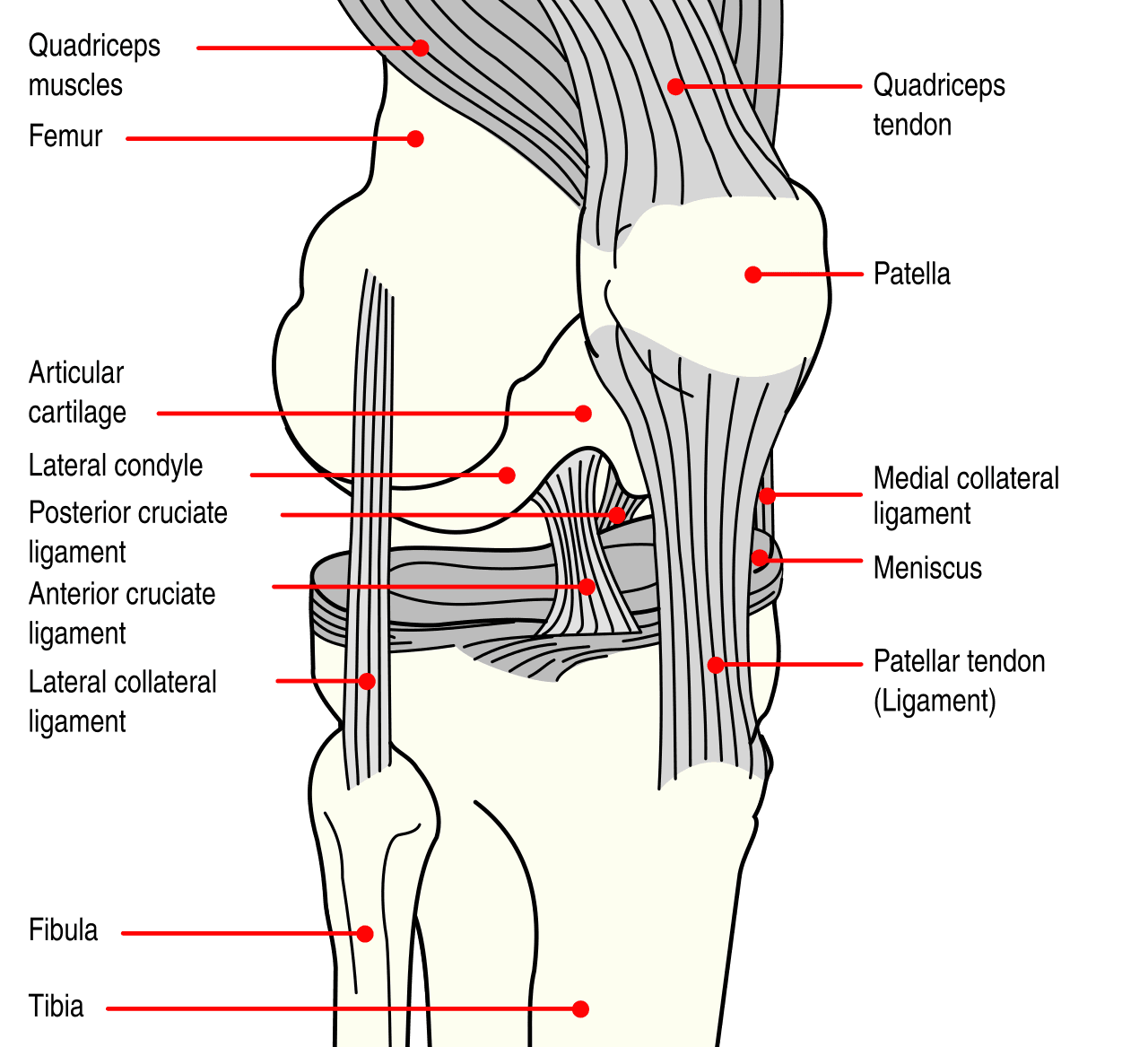
Anatomical diagram of the knee joint, ligaments and cartilage
Image credit: Mysid · Public domain · Rendered as PNG

Knee arthroscopy is a common procedure used to diagnose and treat certain knee problems, but it is not suitable for every case. Knee pain or swelling does not automatically mean that arthroscopy is needed. The decision depends on the cause, how long symptoms have lasted, and the findings of the clinical examination and imaging.
This article explains when knee arthroscopy may be needed and when conservative treatment may be sufficient.
What is knee arthroscopy?
Knee arthroscopy is a procedure in which a small tube fitted with a tiny camera is used to examine the inside of the knee joint. The doctor can also treat certain problems during the procedure without a large open operation.
Arthroscopy is less invasive than traditional surgery, and recovery is often faster in suitable cases.
Which conditions may require knee arthroscopy?
A doctor may recommend knee arthroscopy in selected cases, such as:
A meniscus tear causing persistent pain or knee locking.
A loose body inside the joint that interferes with movement.
Certain injuries to the joint cartilage.
Recurring knee swelling that does not improve with conservative treatment.
Persistent pain with mechanical symptoms such as painful clicking or catching.
A need for detailed assessment of certain internal injuries when standard assessment and treatment have not clarified the problem.
When might I not need knee arthroscopy?
Arthroscopy is often not the first option, especially when symptoms are mild or moderate or improve with time and conservative care.
You may not need arthroscopy if:
Pain is caused by strain or mild inflammation.
The knee does not lock.
There is no clear instability.
Symptoms are starting to improve with physiotherapy.
The problem is related to osteoarthritis that needs a conservative treatment plan first.
Does every meniscus tear need arthroscopy?
No. Some meniscus tears can be treated without an operation, particularly when they do not cause knee locking or severe persistent pain. The decision is not based on the MRI report alone; it also depends on symptoms and their effect on walking, movement, and everyday life.
Which signs may suggest a need for knee arthroscopy?
Certain symptoms make assessment for arthroscopy more important, including:
Knee locking or an inability to straighten the knee fully.
Persistent pain despite an appropriate period of treatment.
Recurring swelling inside the joint.
A feeling of knee instability.
Noticeable difficulty walking or climbing stairs.
Physiotherapy and medication failing to improve the condition.
How does the doctor decide whether arthroscopy is needed?
The decision depends on several factors, including:
The nature and location of the pain.
Swelling, locking, or instability.
Clinical examination findings.
X-rays or an MRI scan.
How long symptoms have lasted.
The effect on everyday activities or sport.
For this reason, a decision about arthroscopy should not be based on imaging alone without a full clinical examination.
What are the benefits of knee arthroscopy?
In suitable cases, benefits may include:
Small incisions rather than open surgery.
Less pain after the procedure in many cases.
Faster recovery.
Detailed assessment of certain problems inside the knee.
The ability to diagnose and treat some conditions during the same procedure.
Is knee arthroscopy painful?
Pain after arthroscopy is often less than after traditional surgery, but its severity depends on the problem and the procedure performed inside the joint. Pain can usually be managed with medication and appropriate postoperative instructions.
How long does recovery take after knee arthroscopy?
Recovery time varies with the condition and the procedure. Some patients return to walking and daily activities relatively soon. Others need several weeks of physiotherapy and rehabilitation, particularly after meniscus repair or a more extensive procedure.
When should you see an orthopedic doctor?
Seek assessment if you have:
Persistent knee pain that is not improving.
Recurring swelling.
Knee locking.
Difficulty moving or walking.
Instability after an injury.
Symptoms that affect work or sport.
Early assessment helps establish whether arthroscopy is needed or whether simpler treatments can be used without delay.
Summary
Knee arthroscopy is useful for specific conditions, but it is not necessary for every case of knee pain. The right decision depends on accurate diagnosis, symptom severity, and the response to conservative treatment. Persistent knee pain or reduced movement is a reason to seek an examination and identify the appropriate treatment.
Read also: ACL and knee meniscus injuries
Medical references
Related articles
Related treatment services
Medical note
Need a medical assessment?
This content is educational and does not replace a medical examination. If pain continues or affects movement, book an appointment to identify the cause and suitable treatment plan.