
Knee
Why Does My Knee Hurt on Stairs? Causes and What Helps
- knee pain
- knee pain on stairs
- knee pain going down stairs
- knee pain climbing stairs
- patellofemoral pain
- runner's knee
- knee osteoarthritis
- meniscus tear
- knee strengthening exercises
- orthopedic doctor in Kuwait
Published by: Dr. Osama Samir Al-Droubi's clinic · Salmiya, Kuwait
Medically reviewed by Dr. Osama Al Droubi on
Last updated
A simple guide to why your knee hurts going up or down stairs, from kneecap pain and arthritis to meniscus tears, plus warning signs and treatments that work without surgery.
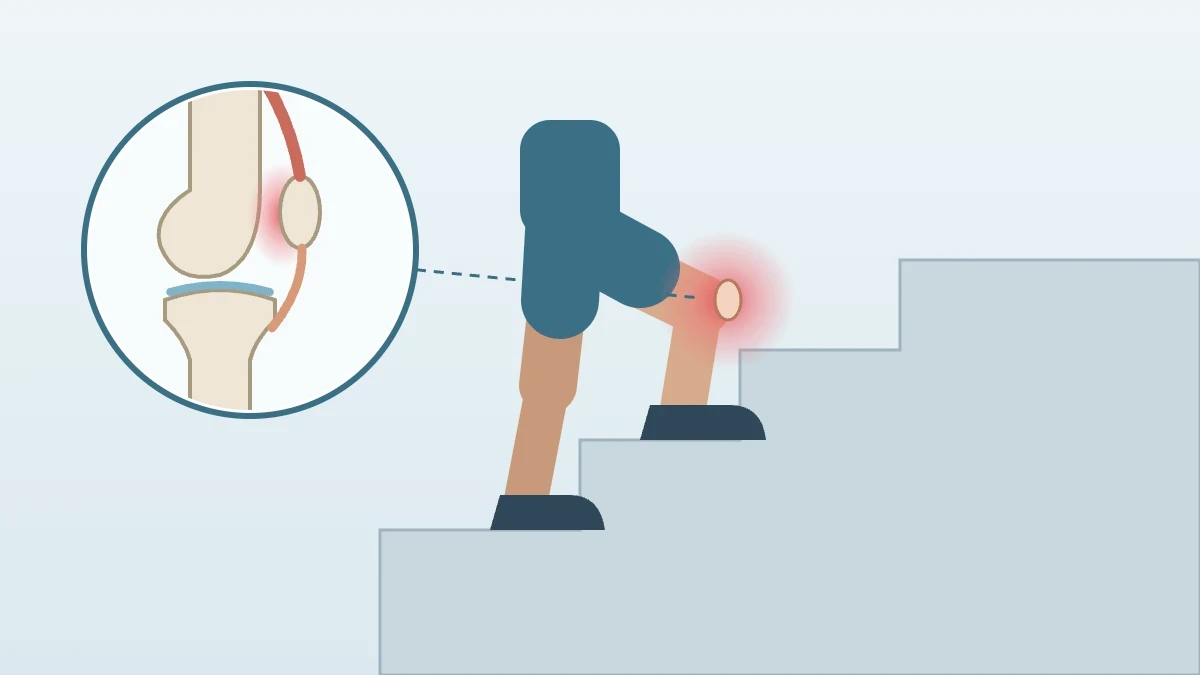
Illustration of knee pain on stairs: a leg climbing a step with pain at the front of the knee, and a close-up of the kneecap joint
Quick answer: If your knee hurts on the stairs but feels fine on flat ground, the most common cause is pain behind or around the kneecap (patellofemoral pain). In people over 40, knee osteoarthritis is also common. A torn meniscus or an irritated kneecap tendon can cause it too. Most people get better without surgery by strengthening the thigh and hip muscles.
Stairs are a simple daily task, but they are hard work for your knees. That is why stairs are often the first place a knee problem shows up.
Why are stairs so hard on the knees?
On stairs, your knee bends more than when you walk, and your whole body weight is lifted or lowered on one leg. This puts much more pressure on the joint between your kneecap and thighbone. Going down is often worse, because your thigh muscle has to work like a brake to control each step.
What are the common causes?
1. Patellofemoral pain ("runner's knee")
This is the most common cause, especially in teens, young adults, active people and women. You feel a dull ache at the front of the knee. It gets worse with stairs, squatting, kneeling, or sitting for a long time with bent knees. Weak thigh and hip muscles are a common trigger.
2. Knee osteoarthritis
This is wear of the smooth cartilage inside the knee and is more common after age 40. Your knee may feel stiff in the morning or after sitting, and it may creak or crunch. Learn more in our guide to osteoarthritis and its best treatments.
3. Meniscus tear
The meniscus is a rubbery cushion inside the knee. It can tear with a twist, or wear down with age. Signs include pain on one side of the knee, swelling, and a feeling that the knee catches, locks or gives way. But not every meniscus tear needs surgery.
4. Jumper's knee
This is irritation of the tendon just below the kneecap. It is common in people who jump or run a lot, and over time it can hurt on stairs or when standing up from a chair. Read more about jumper's knee.
5. Less common causes
Pes anserine bursitis: pain on the inner side, just below the knee.
IT band syndrome: pain on the outer side of the knee, common in runners.
Where does it hurt? A simple guide
Around or behind the kneecap: usually patellofemoral pain.
Just below the kneecap: jumper's knee.
Inner side: osteoarthritis, a meniscus tear, or bursitis.
Outer side: IT band or a meniscus tear.
This is only a rough guide; an exam confirms the cause.
When is knee pain a warning sign?
See a doctor soon if you:
Can't put weight on your leg.
Heard a "pop" and the knee swelled quickly.
Can't fully straighten the knee, or it locks.
Have a red, hot knee with fever.
Have pain at night or at rest that keeps getting worse.
How do doctors find the cause?
Your doctor will ask where it hurts and what makes it worse, then check your knee, hip and the way you walk and squat. Often no scan is needed. A standing X-ray can show arthritis, and an MRI is used when a meniscus or ligament tear is suspected.
How does Dr. Osama Droubi treat knee pain on stairs?
Dr. Osama Droubi treats the cause, not just the X-ray, step by step:
Listen and examine: a detailed history and a careful exam of the knee, hip and walking pattern.
Only the tests you need: an X-ray or MRI only when it will change the treatment.
Simple first steps: pain relief or anti-inflammatory medicine if suitable for you, home exercises, ice, activity changes, and shoe inserts when helpful.
Physical therapy: if there is little improvement after 1–2 weeks.
Injections in selected cases: for example, knee arthritis that has not improved with physical therapy.
Surgery as a last resort: only when all other options fail, or when a torn meniscus locks the knee.
What helps knee pain on stairs?
1. Keep moving, but smarter
Cut back on what hurts, like deep squats or downhill running, for a while. Don't stop moving completely, because rest makes muscles weaker.
2. Strengthen your thighs and hips
This is the most important treatment. Strong thigh and hip muscles take pressure off the kneecap and keep the knee steady.
3. Lose extra weight
For people with knee arthritis who carry extra weight, losing some of it reduces pain and makes moving easier.
4. Pain relief
For arthritis, an anti-inflammatory gel on the knee is a good first choice. Ask your doctor before taking anti-inflammatory tablets, especially if you have stomach, kidney or heart problems.
5. Taping and shoe inserts
Kneecap taping and ready-made shoe inserts can ease pain in the short term when used together with exercise.
6. Injections
Injections are mainly used for knee arthritis when other treatments haven't worked. See our guide to joint injections.
Easy tips for taking the stairs
Going up, step first with your good leg. Going down, step first with the sore leg.
Hold the handrail.
Put your whole foot on each step.
When should I see an orthopedic doctor?
Book a visit if the pain lasts more than two weeks despite home care, started after an injury, or comes with any of the warning signs above.
How can I prevent it?
Keep a healthy weight.
Do thigh and hip strengthening exercises regularly.
Increase exercise slowly.
The bottom line
Knee pain on the stairs is common and usually not serious. In younger people it is most often kneecap pain, and in older people it is often arthritis. Most cases get better with exercise and simple changes, without surgery. If you live in Kuwait and your knee pain isn't going away, book an appointment with Dr. Osama Droubi at his clinic in Salmiya.
Read also: Osteoarthritis, Jumper's Knee, When Should I See an Orthopedic Doctor?
References
American Academy of Orthopaedic Surgeons (AAOS) – OrthoInfo. Patellofemoral Pain Syndrome. https://orthoinfo.aaos.org/en/diseases--conditions/patellofemoral-pain-syndrome/
Willy RW, et al. Patellofemoral Pain: Clinical Practice Guidelines. J Orthop Sports Phys Ther. 2019;49(9):CPG1–CPG95. https://doi.org/10.2519/jospt.2019.0302
NICE. Osteoarthritis in over 16s: diagnosis and management (NG226), 2022. https://www.nice.org.uk/guidance/ng226
American Academy of Orthopaedic Surgeons (AAOS) – OrthoInfo. Meniscus Tears. https://orthoinfo.aaos.org/en/diseases--conditions/meniscus-tears/
Mayo Clinic. Patellar tendinitis. https://www.mayoclinic.org/diseases-conditions/patellar-tendinitis/symptoms-causes/syc-20376113
Medically reviewed by: Dr. Osama Droubi, Specialist Orthopedic Surgeon
Review date: November 24, 2026
Frequently asked questions
Does knee pain on stairs mean I have arthritis?
Not always. In younger people the most common cause is kneecap (patellofemoral) pain. After 40, arthritis becomes more likely. A doctor's exam can tell the difference.
Why does my knee hurt more going down stairs?
Going down, your thigh muscle works like a brake to control each step. This puts more pressure on the kneecap joint, especially if the muscles are weak or you have arthritis.
Should I avoid stairs completely?
Usually not. Cut back for a while, use the handrail, step up with your good leg and down with the sore leg, and keep doing your strengthening exercises.
What exercises help knee pain on stairs?
Exercises that strengthen the front thigh muscles and the hip muscles help the most. A doctor or physical therapist can choose the right ones for you.
Do I need an MRI for knee pain on stairs?
Not always. An MRI is used when a meniscus or ligament tear is suspected, or when pain doesn't improve. A standing X-ray is often enough to check for arthritis.
Will I need surgery?
Rarely. Surgery is considered only when other treatments fail, when a torn meniscus locks the knee, or for severe arthritis that limits daily life.
Medical note
Need a medical assessment?
This content is educational and does not replace a medical examination. If pain continues or affects movement, book an appointment to identify the cause and suitable treatment plan.